Ultimate FRCR Part 1 Study Schedule: A 3-Month (12-Week) Preparation and Revision Plan
FRCR Part 1 3-month study schedule with a practical 12-week plan for physics, anatomy, timed practice, and final revision before the real exam day starts.
Answer First
A three-month FRCR Part 1 study schedule can work well if physics and anatomy are studied in parallel, question practice starts early, and the final month is reserved for timed revision.
Key Facts
- A 12-week plan is commonly divided into foundation, consolidation, and final revision phases.
- Physics and anatomy should be revised together rather than in separate blocks.
- Daily anatomy exposure and regular physics questions are more effective than occasional marathon sessions.
- Timed practice becomes essential in the final four weeks.
Practice
Apply this with real FRCR Part 1 questions
Reinforce today’s topic with targeted practice in the Spotters Academy app.
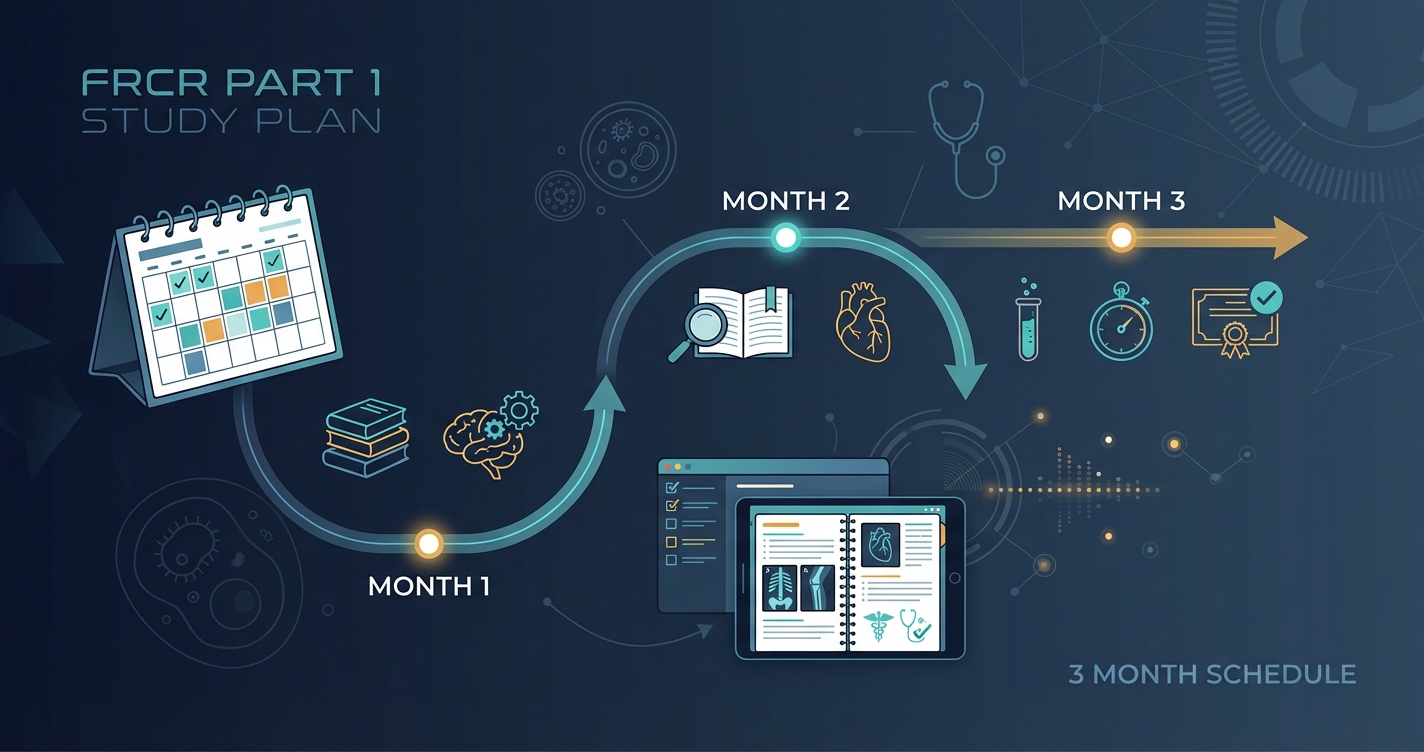
If you’re searching for a FRCR Part 1 3-month study schedule, you’re likely feeling two things at once: urgency and uncertainty.
FRCR candidates often struggle with planning not because they lack time, but because they don’t know how to structure preparation across physics and anatomy within a limited timeframe.
This guide provides a clear, realistic 12-week FRCR Part 1 study and revision plan, showing you exactly what to focus on each phase so you can prepare efficiently without burnout. For the underlying principles behind the plan, see our guide to how to study for FRCR Part 1.
This guide is aligned with the Royal College of Radiologists FRCR Part 1 syllabus.
Is 3 Months Enough to Prepare for FRCR Part 1?
Yes - if your preparation is structured.
Three months is sufficient provided you:
-
Start question practice early
-
Study physics conceptually
-
Expose yourself to anatomy images daily
-
Reserve adequate time for revision and mocks
Unstructured study, even over longer durations, often leads to failure.
How the FRCR Part 1 Exam Is Structured (Quick Reminder)
-
Physics module:
40 question stems, each with 5 True/False statements (120 minutes) -
Anatomy module:
~100 image-based questions (~90 minutes)
Your study schedule must reflect both formats.
FRCR Part 1 3-Month Study Plan: How This Schedule Works
This 12-week plan is divided into three phases:
-
Foundation
-
Consolidation
-
Final revision
Each phase has a distinct purpose.
Phase 1: Foundation (Weeks 1-4)
Goals
-
Build conceptual understanding
-
Start early question practice
-
Establish daily anatomy exposure
Focus Areas
-
Basic anatomy recognition
Daily routine (indicative):
-
Physics study + questions
-
20-30 anatomy images
-
Error log maintenance
Phase 2: Consolidation (Weeks 5-8)
Goals
-
Increase question volume
-
Identify weak areas
-
Improve speed and accuracy
Focus Areas
-
High-yield physics topics (CT physics, dose, artefacts)
-
Timed True/False practice
-
Mixed-modality anatomy practice
Physics and anatomy should now be fully integrated.
Phase 3: Final Revision (Weeks 9-12)
Goals
-
Refine accuracy
-
Build confidence
-
Simulate exam conditions
Focus Areas
-
Full-length mocks
-
Rapid anatomy drills
-
Focused revision of repeated errors
Key rule:
Do not add new resources at this stage.
12-Week FRCR Part 1 Study Schedule (At a Glance)
| Phase | Weeks | Primary Focus |
|---|---|---|
| Foundation | 1-4 | Concepts + light questions |
| Consolidation | 5-8 | Heavy question practice |
| Final Revision | 9-12 | Mocks + rapid revision |
How Much Should You Study Each Day?
A realistic daily target:
-
2-3 hours on weekdays
-
4-6 hours on weekends
Consistency matters more than long study days.
Common Planning Mistakes Candidates Make
Common FRCR study-schedule mistakes include:
-
Spending too long reading before practising
-
Leaving anatomy till the end
-
Ignoring revision time
-
Over-planning without execution
A simple, repeatable schedule works best.
How to Adapt This Schedule If You’re Working Full-Time
-
Short, focused weekday sessions
-
Longer weekend consolidation
-
Daily anatomy exposure (even 20 minutes)
Perfection is not required - consistency is.
Frequently Asked Questions (FAQ)
Is a 3-month FRCR Part 1 study plan enough?
Yes, with structured preparation and early question practice.
When should I start revision?
Revision should intensify from Week 9 onward, not start then.
Should physics or anatomy take priority?
Both are equally important and should be studied in parallel.
Can I modify this schedule?
Yes, adapt timing, not structure.
What is the biggest mistake candidates make?
Poor planning and late revision.
Final Advice
A well-structured 3-month FRCR Part 1 study schedule is often more effective than longer, unplanned preparation.
Focus on:
-
concepts
-
questions
-
revision
and the exam becomes manageable. To slot the physics topics into this timeline, follow the FRCR Part 1 physics study guide.
Author
Dr B Gayathri Priyadharshinee
FRCR Radiologist & Educator
Dr Gayathri mentors radiology trainees for international exams, focusing on structured preparation, exam logic, and sustainable study strategies.
Sources and further reading
Checked on 10 June 2026.
Sources
Dr. Gayathri Priyadharshinee
Expert content from the Spotters Academy team. We're dedicated to helping radiologists succeed in their FRCR Part 1 examination.
Ready to ace your FRCR Part 1?
Join thousands of successful candidates who prepared with Spotters Academy.
Start Free Trial