Ultimate Guide to Ultrasound Physics for FRCR Part 1 Explained
Ultrasound physics for FRCR Part 1 explained clearly, including frequency, impedance, Doppler, artefacts, safety, and the trade-offs examiners test most.
Answer First
Ultrasound physics in FRCR Part 1 is mainly about understanding image formation through sound reflection, how frequency changes resolution and penetration, and why common artefacts occur.
Key Facts
- Higher frequency improves resolution but reduces penetration.
- Acoustic impedance differences determine how strongly echoes are reflected.
- Doppler angle and aliasing are repeatedly tested principles.
- Artefacts such as shadowing, enhancement, and reverberation are high-yield because they reveal underlying physics.
Practice
Apply this with real FRCR Part 1 questions
Reinforce today’s topic with targeted practice in the Spotters Academy app.
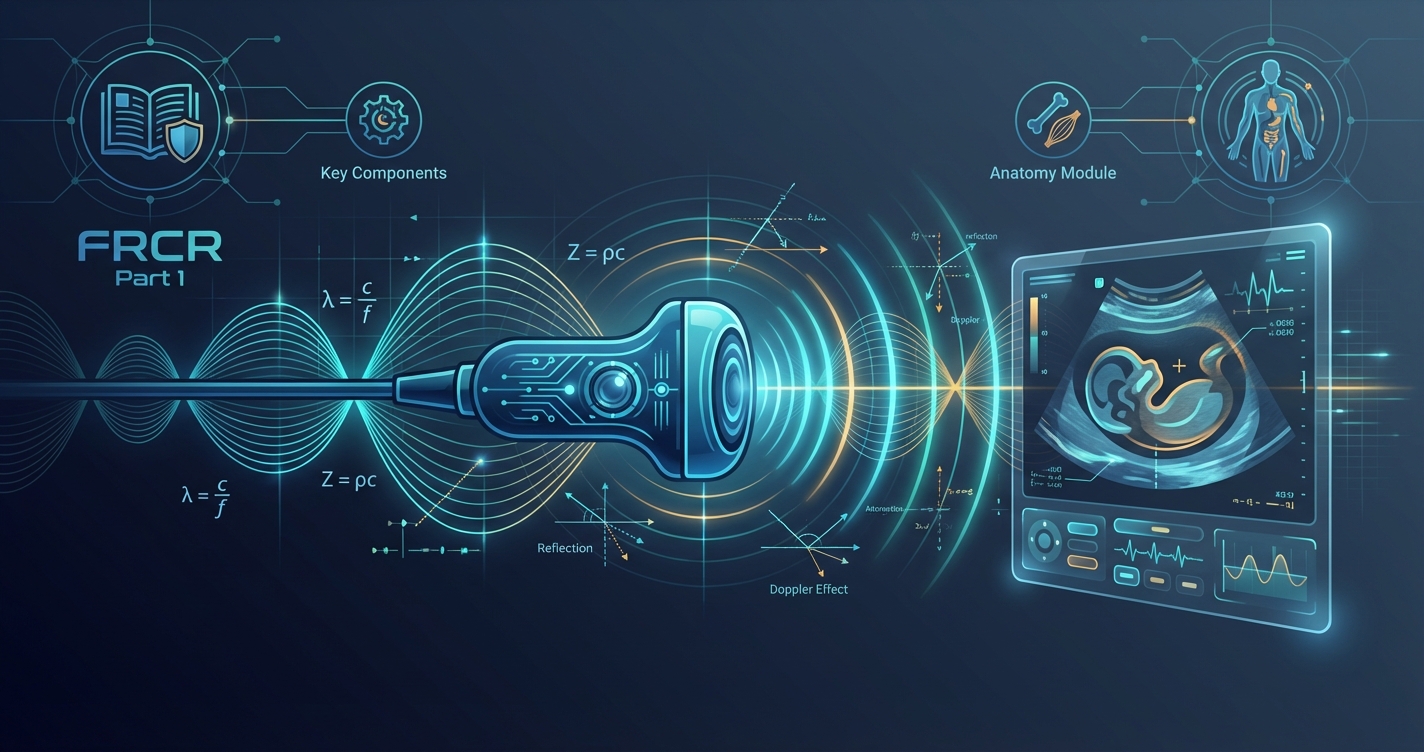
Ultrasound physics is one of the most confusing and under-scored sections of FRCR Part 1 physics.
FRCR candidates often struggle with ultrasound physics because concepts like attenuation, impedance, Doppler, and artefacts are taught as formulas rather than as image-forming principles. This leads to memorisation without understanding - and poor True/False accuracy in the exam.
This ultimate guide to ultrasound physics for FRCR Part 1 explains the concepts simply, logically, and exam-focused, showing you what examiners test, what they don’t, and how to study ultrasound physics efficiently.
This guide is aligned with the Royal College of Radiologists FRCR Part 1 physics syllabus.
Why Ultrasound Physics Is Important for FRCR Part 1
Ultrasound physics is tested because it assesses:
-
understanding of sound-based image formation
-
interaction of sound with tissues
-
artefacts and their physical basis
-
Doppler principles
FRCR questions are concept-based, not calculation-heavy.
What Does FRCR Expect You to Know in Ultrasound Physics?
For FRCR Part 1, you are expected to understand:
-
how ultrasound images are formed
-
factors affecting image quality
-
common artefacts and why they occur
-
basic Doppler principles
You are not expected to memorise advanced mathematics or machine engineering.
Basic Principles of Ultrasound Physics (Explained Simply)
1️⃣ What Is Ultrasound?
Ultrasound uses high-frequency sound waves (not radiation, unlike X-ray and CT imaging) to create images.
-
Sound is transmitted into the body
-
Echoes are reflected back from tissue interfaces
-
The machine converts these echoes into an image
Key FRCR concept:
Ultrasound imaging is based on reflection and time delay, not transmission.
2️⃣ Frequency and Resolution
-
Higher frequency
-
Better resolution
-
Less penetration
-
-
Lower frequency
-
Poorer resolution
-
Greater penetration
-
This trade-off is very commonly tested.
Acoustic Impedance: A Core FRCR Topic
Acoustic impedance depends on:
-
tissue density
-
speed of sound in tissue
Greater difference in impedance → stronger reflection → brighter echo.
This explains:
-
strong echoes at soft tissue-air interfaces
-
poor visualisation beyond gas or bone
Attenuation and Its Effects
As ultrasound travels through tissue, it loses energy due to:
-
absorption
-
scattering
-
reflection
Attenuation:
-
increases with frequency
-
limits penetration depth
FRCR pearl:
Higher frequency probes attenuate more quickly.
Image Quality Parameters in Ultrasound
Spatial Resolution
Determined by:
-
wavelength
-
frequency
-
beam width
Higher frequency → shorter wavelength → better resolution.
Axial vs Lateral Resolution
-
Axial resolution: along the beam path
-
Lateral resolution: perpendicular to the beam
Axial resolution is usually better than lateral resolution - a common exam point.
Common Ultrasound Artefacts (High-Yield for FRCR)
Acoustic Shadowing
-
Occurs behind highly attenuating structures
-
Seen behind bone and calcification
Posterior Acoustic Enhancement
-
Occurs behind fluid-filled structures
-
Due to reduced attenuation
Reverberation
-
Multiple reflections between interfaces
-
Produces repeating echoes
Mirror Image
- Strong reflectors create duplicated structures
Understanding why artefacts occur is more important than recognising their appearance, the same principle that applies to CT artefacts.
Doppler Ultrasound Physics
What Doppler Measures
- Change in frequency due to moving reflectors (blood)
Doppler Angle
-
Maximum Doppler shift at 0°
-
No Doppler signal at 90°
Angle dependence is very commonly tested.
Aliasing
Occurs when:
-
Doppler shift exceeds Nyquist limit
-
Seen in pulsed Doppler
Colour aliasing does not occur in continuous-wave Doppler.
Safety in Ultrasound (FRCR Focus)
Ultrasound is considered safe but involves:
-
Thermal Index (TI)
-
Mechanical Index (MI)
FRCR questions often test:
-
safety awareness
-
ALARA principles
-
situations requiring caution
Ultrasound Physics for FRCR Part 1: At a Glance
| Topic | Exam Priority |
|---|---|
| Frequency vs penetration | Very high |
| Acoustic impedance | Very high |
| Attenuation | High |
| Artefacts | Very high |
| Doppler principles | High |
| Ultrasound safety | Moderate |
Common Ultrasound Physics Mistakes in FRCR
Common FRCR ultrasound errors include:
-
confusing frequency and penetration
-
memorising artefacts without understanding
-
misunderstanding Doppler angle effects
-
ignoring safety indices
Most mistakes are conceptual, not factual.
How to Study Ultrasound Physics for FRCR Part 1
-
Focus on concepts, not formulas
-
Use diagrams to visualise sound interaction
-
Practise True/False questions early
-
Revise artefacts repeatedly
-
Avoid over-memorisation
Ultrasound physics becomes easy once the logic is clear.
Frequently Asked Questions (FAQ)
Is ultrasound physics heavily tested in FRCR Part 1?
Yes. It is a core physics topic and commonly tested conceptually.
Do I need to memorise ultrasound equations?
No. Understanding relationships matters more.
Is Doppler physics important?
Yes. Especially angle dependence and aliasing.
Are ultrasound artefacts high-yield?
Very high-yield.
What is the most common ultrasound physics mistake?
Confusing frequency, penetration, and resolution.
Final Takeaway
Ultrasound physics for FRCR Part 1 is not about memorisation.
It is about:
-
understanding sound-tissue interaction
-
recognising cause-effect relationships
-
applying logic under exam conditions
Candidates who master these concepts consistently score well. To see how ultrasound fits with the other physics topics and plan your revision, follow the FRCR Part 1 physics study guide.
Author
Dr B Gayathri Priyadharshinee
FRCR Radiologist & Educator
Dr Gayathri mentors radiology trainees for international exams, focusing on physics clarity, exam logic, and high-yield preparation strategies.
For a structured topic-by-topic plan, see our FRCR Part 1 physics revision guide.
Sources and further reading
Checked on 10 June 2026.
Tags
Sources
Dr. Gayathri Priyadharshinee
Expert content from the Spotters Academy team. We're dedicated to helping radiologists succeed in their FRCR Part 1 examination.
Ready to ace your FRCR Part 1?
Join thousands of successful candidates who prepared with Spotters Academy.
Start Free Trial