Understanding X-Ray Production and Interactions for FRCR Part 1 (Explained Simply)
X-ray production and interactions for FRCR Part 1 explained clearly, from bremsstrahlung and filtration to Compton scatter, contrast, dose, and tested effects.
Answer First
X-ray production and interactions for FRCR Part 1 are mainly about how electrons generate photons, how beam quality and quantity change, and how photoelectric and Compton effects influence contrast and dose.
Key Facts
- Bremsstrahlung produces the continuous X-ray spectrum and is a high-yield FRCR topic.
- kVp changes beam quality, while mAs changes photon quantity.
- Photoelectric effect increases contrast and dose, while Compton scatter reduces contrast and increases scatter exposure.
- Filtration removes low-energy photons and reduces unnecessary skin dose.
Practice
Apply this with real FRCR Part 1 questions
Reinforce today’s topic with targeted practice in the Spotters Academy app.
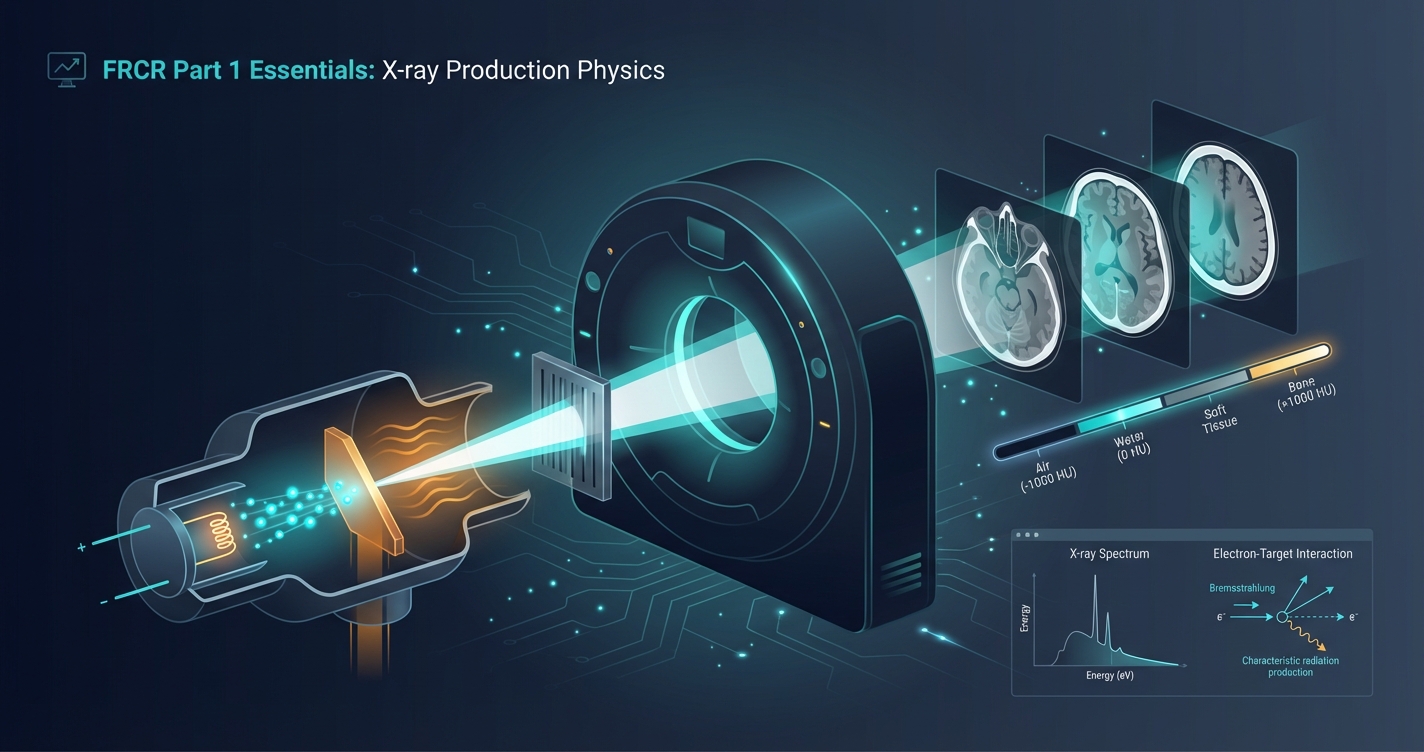
X-ray production and X-ray interactions are among the most fundamental yet most confusing topics in FRCR Part 1 physics.
FRCR candidates often struggle with X-ray physics because concepts like bremsstrahlung, characteristic radiation, filtration, and photoelectric vs Compton interactions are taught as disconnected facts - leading to memorisation without understanding and poor True/False accuracy in the exam.
This guide explains X-ray production and interactions for FRCR Part 1 in a simple, logical, exam-focused way, showing you what examiners test, how to think about X-ray physics, and what you do not need to over-memorise.
This guide is aligned with the Royal College of Radiologists FRCR Part 1 physics syllabus.
Why X-Ray Production and Interactions Matter for FRCR Part 1
X-ray physics forms the foundation of:
-
plain radiography
-
fluoroscopy
FRCR questions frequently link X-ray production → beam properties → image contrast → dose → interactions. Understanding this chain is essential.
What Does FRCR Expect You to Know in X-Ray Physics?
For FRCR Part 1, you are expected to understand:
-
how X-rays are produced
-
factors affecting X-ray beam quality and quantity
-
how X-rays interact with matter
-
how these interactions affect image contrast and dose
You are not expected to memorise tube engineering or advanced equations.
X-Ray Production Explained Simply
1️⃣ Basic Principle of X-Ray Production
X-rays are produced when high-speed electrons strike a metal target inside the X-ray tube.
-
Electrons are released from the cathode
-
Accelerated across a high voltage (kVp)
-
Suddenly decelerated at the anode
This loss of kinetic energy produces X-rays.
2️⃣ Bremsstrahlung Radiation (Very High-Yield)
-
Caused by electron deceleration near the nucleus
-
Produces a continuous spectrum
-
Responsible for the majority of diagnostic X-rays
FRCR pearl:
Bremsstrahlung intensity increases with kVp and atomic number of the target.
3️⃣ Characteristic Radiation
-
Occurs when an inner-shell electron is ejected
-
Outer-shell electrons drop down to fill the vacancy
-
Produces discrete energy peaks
Characteristic radiation contributes less to the beam but is frequently tested conceptually.
Factors Affecting the X-Ray Beam
kVp (Beam Quality)
-
Determines maximum photon energy
-
Higher kVp → more penetrating beam
-
Affects contrast and dose
mAs (Beam Quantity)
-
Determines number of photons
-
Higher mAs → increased dose
-
Does not affect photon energy
Filtration
-
Removes low-energy photons
-
Reduces patient skin dose
-
Increases average beam energy
Filtration is a radiation protection concept, not just physics.
X-Ray Interactions with Matter (High-Yield for FRCR)
Photoelectric Effect
-
Complete absorption of X-ray photon
-
Occurs at low kVp
-
Strongly dependent on atomic number (Z³)
Impact:
-
Increases image contrast
-
Increases patient dose
Compton Scatter
-
Partial energy loss
-
Occurs at higher kVp
-
Independent of atomic number
Impact:
-
Reduces image contrast
-
Major contributor to scatter and occupational exposure
Coherent (Rayleigh) Scatter
-
Low-energy interaction
-
Minimal diagnostic significance
-
Rarely tested beyond recognition
Photoelectric vs Compton: A Core FRCR Comparison
| Feature | Photoelectric | Compton |
|---|---|---|
| Energy | Low kVp | Higher kVp |
| Z dependence | Strong | None |
| Effect on contrast | Increases | Reduces |
| Effect on dose | Higher | Lower |
| Exam relevance | Very high | Very high |
Understanding when each dominates is more important than definitions.
How X-Ray Interactions Affect Image Contrast
-
Low kVp → more photoelectric effect → higher contrast
-
High kVp → more Compton scatter → lower contrast
FRCR questions often test why contrast changes, not just what changes.
Radiation Dose Implications (FRCR Focus)
-
Photoelectric effect increases patient dose
-
Compton scatter increases staff exposure
-
Filtration and collimation reduce unnecessary dose
Dose questions are often embedded within interaction questions, so it helps to study this alongside our guide to radiation dosimetry for FRCR Part 1.
X-Ray Physics for FRCR Part 1: At a Glance
| Concept | Exam Priority |
|---|---|
| Bremsstrahlung | Very high |
| Characteristic radiation | High |
| kVp vs mAs | Very high |
| Filtration | High |
| Photoelectric effect | Very high |
| Compton scatter | Very high |
| Contrast vs dose | Very high |
Common X-Ray Physics Mistakes in FRCR
Common FRCR X-ray physics errors include:
-
confusing kVp and mAs effects
-
memorising interactions without understanding contrast implications
-
forgetting Z-dependence of photoelectric effect
-
underestimating dose implications
Most mistakes arise from fragmented learning.
How to Study X-Ray Physics for FRCR Part 1
-
Understand cause → effect chains
-
Use diagrams to visualise interactions
-
Practise True/False questions early
-
Focus on contrast and dose reasoning
-
Avoid equation-heavy memorisation
Once the logic is clear, X-ray physics becomes predictable.
Frequently Asked Questions (FAQ)
Is X-ray production heavily tested in FRCR Part 1?
Yes. It is a foundational topic and appears frequently.
Do I need to memorise X-ray spectra?
No. Understand why spectra change.
Which interaction is most important for the exam?
Photoelectric and Compton interactions.
Is filtration important?
Yes - especially for dose reduction concepts.
What is the most common mistake candidates make?
Learning interactions without linking them to image contrast.
Final Takeaway
X-ray production and interactions for FRCR Part 1 are not about memorisation.
They are about:
-
understanding how X-rays are created
-
knowing how they interact with tissues
-
linking physics to contrast and dose
Candidates who understand these principles consistently perform well. To see how X-ray physics connects to the rest of the syllabus and plan your revision, follow the FRCR Part 1 physics study guide.
Author
Dr B Gayathri Priyadharshinee
FRCR Radiologist & Educator
Dr Gayathri mentors radiology trainees for international exams, focusing on physics clarity, exam logic, and high-yield preparation strategies.
For a structured topic-by-topic plan, see our FRCR Part 1 physics revision guide.
Sources and further reading
Checked on 10 June 2026.
Sources
Dr. Gayathri Priyadharshinee
Expert content from the Spotters Academy team. We're dedicated to helping radiologists succeed in their FRCR Part 1 examination.
Ready to ace your FRCR Part 1?
Join thousands of successful candidates who prepared with Spotters Academy.
Start Free Trial